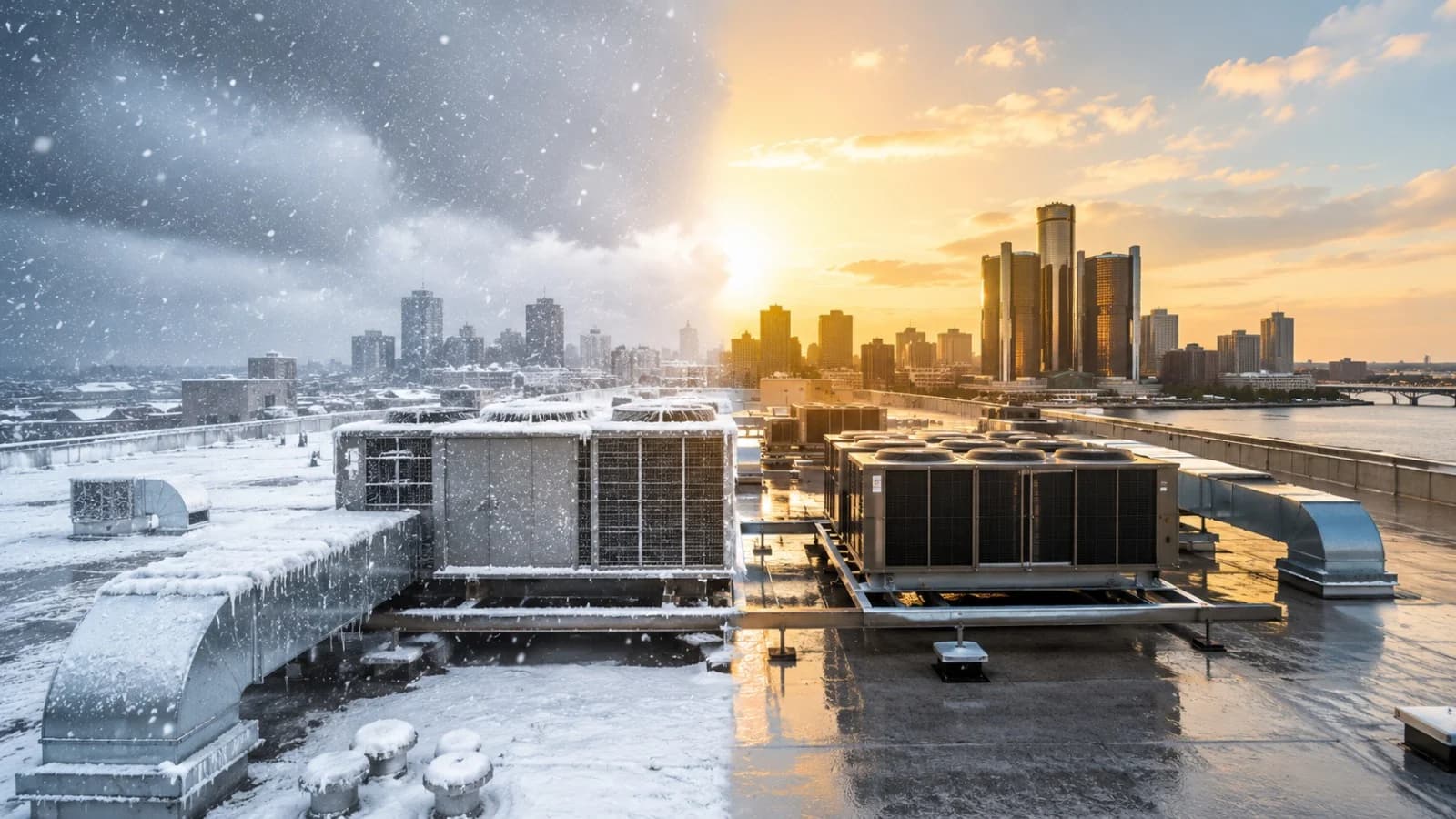
Detroit is known for its changing weather conditions. Businesses in the city can experience hot and humid summers, freezing winters, heavy snowfall, strong winds, rain, and rapid temperature changes throughout the year. These conditions do more than affect people heading to work. They also put considerable pressure on commercial heating and cooling equipment.
For commercial buildings, maintaining a comfortable indoor environment is not simply about keeping employees comfortable. HVAC systems help protect equipment, maintain air quality, control humidity, preserve inventory, and support daily operations. When a commercial HVAC system is not prepared for Detroit's climate, extreme weather can increase energy consumption, accelerate equipment wear, and contribute to unexpected breakdowns.
Understanding the relationship between Detroit weather and commercial HVAC systems can help business owners and facility managers make better maintenance decisions. Seasonal inspections, timely repairs, proper system sizing, and professional HVAC service can all help a commercial system perform more reliably throughout the year.
Commercial HVAC equipment in Detroit has to handle two very different extremes.
During summer, air conditioning systems may operate for long periods as outdoor temperatures rise. High humidity can make indoor spaces feel warmer and place additional demand on cooling equipment.
Winter presents an entirely different challenge. Heating systems may run continuously during periods of freezing temperatures. Snow, ice, wind, and extremely cold outdoor conditions can affect heating equipment, ventilation systems, rooftop units, and other components.
The transition between seasons can also be demanding. A building may require heating in the morning and cooling later in the day. This constant adjustment can increase the workload on HVAC equipment.
For this reason, commercial HVAC maintenance in Detroit should account for seasonal weather rather than treating HVAC service as an occasional repair task.
Winter is one of the most demanding seasons for commercial heating equipment.
When outdoor temperatures drop significantly, heating systems must work harder to maintain the temperature selected by building occupants. Furnaces, boilers, heat pumps, rooftop heating units, and other systems can experience extended operating cycles.
If equipment is already suffering from worn components or restricted airflow, winter conditions can expose those problems quickly.
Cold weather naturally increases the amount of work required from a heating system.
A commercial building loses heat through doors, windows, walls, roofs, and other openings. The colder it is outside, the greater the difference between indoor and outdoor temperatures. HVAC equipment must compensate for that heat loss.
If the system is poorly maintained, it may run longer than necessary. This can increase energy consumption and place additional stress on motors, electrical components, heat exchangers, belts, and other parts.
Extremely cold weather can create problems for water-based HVAC systems and exposed components.
Commercial buildings with boilers, hydronic heating systems, cooling towers, or water lines may face freezing risks if vulnerable areas are not adequately protected. Frozen water can expand and potentially damage pipes and connected components.
Proper insulation, monitoring, and preventative maintenance are especially important before severe winter weather arrives.
Many commercial buildings use rooftop HVAC units because they save interior space and provide efficient access for service technicians. However, rooftop equipment is directly exposed to Detroit's winter weather.
Snow and ice can accumulate around equipment, vents, drains, and other components. Heavy accumulation may interfere with airflow or drainage.
Blocked drains can become particularly problematic. When melted snow or ice cannot drain properly, water may collect and potentially freeze again when temperatures fall.
Facility managers should make sure rooftop equipment remains accessible and that drainage paths are kept clear.
Regular professional inspections can help identify winter-related problems before they become expensive repairs.
Detroit summers can bring periods of high heat and humidity. Commercial buildings often rely heavily on air conditioning during these conditions.
Cooling systems remove heat from indoor spaces and transfer it outside. When outdoor temperatures rise, the system may need to operate longer to maintain the desired indoor temperature.
This is especially challenging for large buildings with high occupancy levels, extensive windows, computer equipment, lighting, or other internal heat sources.
During very warm weather, commercial air conditioners may run for extended periods.
Long operating cycles are not necessarily a sign of a problem. However, if a system runs almost continuously without adequately cooling the building, there may be an underlying issue.
Possible causes include:
A professional HVAC inspection can determine whether the system is operating normally or struggling because of a mechanical issue.
Temperature is not the only summer concern. Humidity can also affect commercial HVAC performance.
Air conditioning systems are designed to remove both heat and some moisture from indoor air. When outdoor humidity is high, the HVAC system may need to work harder to maintain a comfortable indoor environment.
Excessive indoor humidity can make a building feel uncomfortable even when the thermostat displays a reasonable temperature.
High humidity may also contribute to condensation and moisture-related problems if the HVAC system is not operating correctly.
For offices, retail spaces, restaurants, warehouses, healthcare facilities, and other commercial properties, maintaining appropriate indoor humidity can be an important part of overall building comfort.
Detroit weather can change quickly, particularly during transitional seasons.
A building may need heating one day and cooling shortly afterward. These changes can cause HVAC systems to switch operating modes more frequently.
Commercial HVAC equipment is designed to handle changing conditions, but older or poorly maintained systems may struggle.
Components that have been operating near the end of their service life may fail when the system is placed under sudden additional demand.
This is one reason seasonal maintenance is valuable. Identifying worn components before extreme weather arrives can reduce the possibility of emergency service calls.
Strong winds can create another challenge for commercial HVAC systems, especially rooftop equipment.
Outdoor HVAC components are exposed to wind throughout the year. Strong winds can carry dirt, leaves, branches, and other debris toward outdoor units and ventilation openings.
Debris can restrict airflow or collect around equipment.
Wind can also affect building pressure and ventilation. Depending on the building's design, excessive air infiltration can make it more difficult for the HVAC system to maintain indoor temperature.
Regular inspections can help identify damaged panels, loose components, blocked openings, and other problems associated with severe weather.
Proper airflow is essential for commercial HVAC performance in every season.
During winter, restricted airflow can reduce heating performance and cause heating equipment to operate inefficiently. During summer, poor airflow can prevent cooled air from being distributed properly throughout the building.
A simple problem such as a heavily clogged filter can have a surprisingly large effect on system performance.
Commercial properties should follow an appropriate filter replacement schedule based on the building, HVAC equipment, occupancy, and operating conditions.
Professional technicians can also inspect:
Maintaining these components helps the HVAC system move conditioned air efficiently.
Extreme weather can also influence commercial HVAC operating costs.
When heating or cooling equipment operates for longer periods, it generally consumes more energy. Poor maintenance can make the situation worse because inefficient equipment may require additional runtime to achieve the same indoor temperature.
For example, a commercial air conditioner with dirty coils may have difficulty transferring heat efficiently. A heating system with restricted airflow may also struggle to distribute warm air effectively.
Preventative commercial HVAC maintenance can help identify efficiency problems before they result in excessive energy consumption.
Businesses can also benefit from programmable or smart controls that adjust temperatures according to occupancy schedules. There is little reason to heat or cool an empty commercial building to the same level required during operating hours.
Waiting for an HVAC system to fail is rarely the best approach for a commercial property.
Preventative maintenance focuses on identifying potential problems before they develop into major failures.
A professional maintenance program may include inspection, cleaning, testing, adjustment, and replacement of worn components.
For Detroit businesses, seasonal maintenance is particularly useful.
Before Winter
A winter HVAC inspection may include:
Before Summer
A summer HVAC inspection may include:
Preparing equipment before the season of highest demand can reduce the likelihood of unexpected problems.
Weather conditions are an important consideration when selecting or replacing commercial HVAC equipment.
An HVAC system that is too small may struggle to maintain comfortable indoor temperatures during extreme Detroit weather.
A system that is significantly oversized is not necessarily better. Oversized equipment may cycle too frequently and may not control humidity effectively.
Proper load calculations and professional system design help determine the appropriate equipment capacity for a particular commercial building.
Factors such as building size, insulation, windows, occupancy, equipment loads, ventilation requirements, and local climate conditions should be considered.
The age and condition of an HVAC system can make a significant difference during severe weather.
Older equipment may have less efficient components, outdated controls, worn motors, deteriorating electrical connections, or other problems.
That does not automatically mean an older system needs to be replaced. Professional inspection can help determine whether repair, maintenance, or replacement makes the most practical sense.
However, if a system experiences frequent breakdowns, rising energy costs, inconsistent temperatures, or expensive repairs, upgrading the equipment may eventually become more economical.
Modern commercial HVAC systems can offer improved efficiency, better controls, and more precise temperature management when properly selected and installed.
Commercial HVAC systems do more than heat and cool a building. They also play a role in indoor air circulation and ventilation.
During Detroit's coldest months, businesses may keep windows and doors closed more often. During hot weather, buildings may also rely heavily on mechanical ventilation and air conditioning.
Proper filtration, ventilation, humidity management, and regular equipment maintenance can contribute to a healthier and more comfortable indoor environment.
Businesses with specific indoor air quality requirements should work with qualified HVAC professionals to determine the appropriate filtration and ventilation strategy for their building.
Weather-related HVAC problems do not always begin with a complete breakdown.
There are often warning signs that indicate a system should be inspected.
Watch for:
Addressing these signs early may prevent a small repair from becoming a major emergency.
Commercial HVAC systems are larger and more complex than typical residential equipment. They may involve multiple rooftop units, sophisticated controls, large duct networks, boilers, ventilation systems, cooling equipment, and other components.
Professional HVAC technicians have the tools and knowledge needed to diagnose these systems properly.
Instead of simply replacing a failed component, a technician can investigate why the component failed and determine whether another issue is contributing to the problem.
This approach is particularly valuable when equipment is exposed to Detroit's changing weather conditions throughout the year.
A practical seasonal strategy can help businesses stay ahead of weather-related HVAC problems.
Before winter, schedule a heating inspection and make sure outdoor equipment, drainage areas, and vulnerable components are ready for freezing temperatures.
Before summer, have the cooling system inspected and cleaned. Check filters, coils, condensate drains, controls, and other key components.
Throughout the year, monitor unusual temperature changes, energy consumption, airflow, and equipment noises.
It is also helpful to keep maintenance records. Documentation can show when equipment was serviced, which components were replaced, and whether recurring problems are developing.
For larger commercial properties, facility managers can create a preventative maintenance schedule that accounts for equipment age, operating hours, building use, and seasonal demand.
When selecting a commercial HVAC contractor, businesses should look for a company capable of handling the type and size of equipment installed in their property.
Experience with commercial systems is important because commercial HVAC equipment can involve specialized controls and components.
Businesses should also consider whether the contractor provides both HVAC repair and preventative maintenance. Having a reliable service provider available before an emergency occurs can make it easier to respond quickly when equipment problems develop.
A good commercial HVAC provider should be able to inspect existing systems, diagnose problems, recommend practical solutions, and explain maintenance or replacement options clearly.
For Detroit businesses looking for professional heating and cooling support, Desert in Alaska provides commercial HVAC services designed to help businesses maintain reliable indoor comfort throughout changing weather conditions. From routine maintenance and system inspections to troubleshooting and HVAC repairs, professional service can help keep commercial equipment operating efficiently when Detroit temperatures rise, fall, or change unexpectedly.
Explore Commercial HVAC Services in Detroit from Desert in Alaska
Whether your building needs seasonal HVAC maintenance, troubleshooting for an existing system, or professional assistance with commercial heating and cooling equipment, working with an experienced HVAC service provider can help you prepare for Detroit's demanding climate.
Commercial HVAC Services Detroit
Detroit's changing weather puts commercial HVAC systems to the test throughout the year. Freezing winter temperatures, snow, ice, summer heat, humidity, strong winds, and rapid seasonal changes can all influence HVAC performance, energy consumption, equipment wear, and indoor comfort.
The best way to reduce weather-related HVAC problems is to stay proactive. Regular inspections, preventative maintenance, proper airflow, timely repairs, and appropriate equipment selection can help commercial HVAC systems operate more reliably.
For Detroit businesses, preparing an HVAC system before extreme weather arrives is far better than waiting for a breakdown in the middle of a freezing winter or a hot summer day. With professional commercial HVAC service and a consistent maintenance strategy, businesses can protect their equipment, improve comfort, and keep their operations running smoothly through every season.